The five days of Diwali: from Dhanteras to Bhai Dooj
Dhanteras, Naraka Chaturdashi, Lakshmi Puja, Govardhan Puja and Bhai Dooj: the stories, the regional differences, and the 2026 dates for New Delhi.

On this page
In brief
- 1Diwali runs from Dhanteras to Bhai Dooj; the new-moon evening of Lakshmi Puja is its centre.
- 2Each day has its own story: Lakshmi and Dhanvantari, Krishna and Narakasura, Rama's return, Govardhan and Bali, Yama and Yamuna.
- 3In 2026 (New Delhi): Dhanteras 6 Nov, Naraka Chaturdashi and Lakshmi Puja 8 Nov, Govardhan Puja 10 Nov, Bhai Dooj 11 Nov.
Diwali, or Deepavali, takes its name from the Sanskrit for "a row of lamps". Many people think of it as one night, the new-moon evening of Lakshmi Puja, but in most of India it is a five-day festival. It begins with Dhanteras and ends with Bhai Dooj, and each day has its own rites and its own stories.1
The festival falls at the turn of two lunar months. In the amanta calendar used in much of the South and West, where months end at the new moon, the central night is the Amavasya (new moon) of Ashvin. In the purnimanta calendar common in the North, where months end at the full moon, the same night is called the Amavasya of Kartika.
In December 2025, UNESCO added Deepavali to its list of the intangible cultural heritage of humanity, at a session held at the Red Fort in New Delhi.6
The five days at a glance
- Dhanteras · Friday 6 November 2026
- Trayodashi, the thirteenth lunar day of the waning moon. Lakshmi and Kubera are worshipped at dusk and a lamp for Yama is lit outside.
- Naraka Chaturdashi (Choti Diwali) · Sunday 8 November 2026, before sunrise
- Chaturdashi, the fourteenth lunar day. Krishna's victory over Narakasura is remembered with an oil bath before dawn and lamps after dark.
- Lakshmi Puja · Sunday 8 November 2026, evening
- Amavasya, the new moon. The main night: Lakshmi and Ganesha are worshipped after sunset; in Bengal, Odisha and Assam, Kali.
- Govardhan Puja and Bali Pratipada · Tuesday 10 November 2026
- Pratipada, the first lunar day of the bright fortnight. Krishna's lifting of Govardhan hill is honoured; Maharashtra keeps Bali Padva and Gujarat its New Year.
- Bhai Dooj · Wednesday 11 November 2026
- Dwitiya, the second lunar day. Sisters apply a tilak to their brothers and pray for their long life.
In 2026 the five days stretch over six calendar dates. At New Delhi, Chaturdashi is current at dawn on 8 November and Amavasya begins later that morning, so Naraka Chaturdashi and Lakshmi Puja fall on the same day. Amavasya then lasts into the morning of 9 November, which leaves a gap day before Govardhan Puja on 10 November.
Day one: Dhanteras
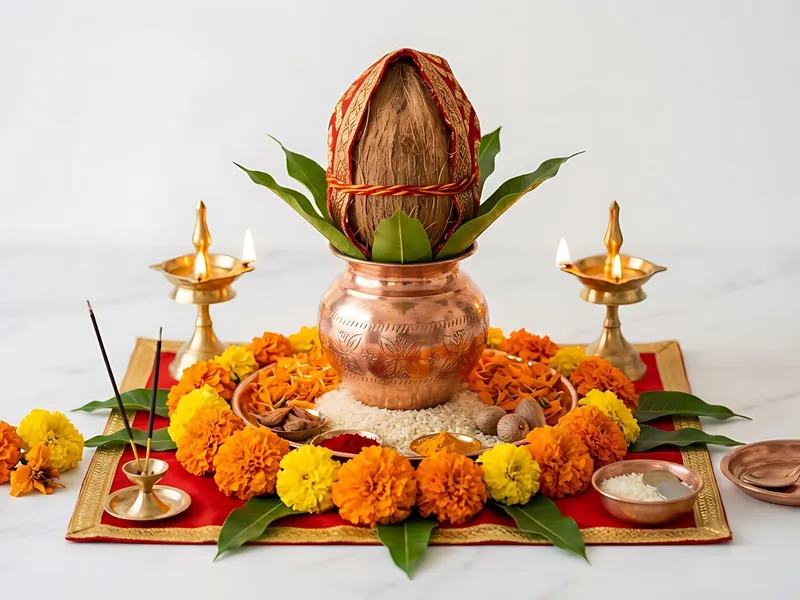
Dhanteras, or Dhantrayodashi, combines dhan (wealth) with teras (thirteenth). In the evening Lakshmi is worshipped alongside Kubera, the keeper of wealth, and buying something new in metal, whether a utensil, a coin or jewellery, is a widespread custom.2
The day is also Dhanvantari Jayanti. Tradition holds that Dhanvantari, the divine physician linked with Ayurveda, rose from the churning of the cosmic ocean on this day, carrying a pot of amrita. After dark, many families light Yama Deepam, a single lamp placed outside the home for Yama, lord of death, with a prayer that no member of the household meets an untimely end.
Day two: Naraka Chaturdashi
The second day remembers Krishna's defeat of Narakasura, a demon king whose fall set his captives free. Its central rite is abhyanga snana, a bath taken before sunrise after rubbing the body with sesame oil and a herbal paste. The day is also called Choti Diwali (little Diwali), Roop Chaturdashi and Roop Chaudas.
In Tamil Nadu and much of the South, this pre-dawn hour is the heart of Deepavali itself: an oil bath, new clothes, sweets and lamps before the sun is up. In parts of western India, especially Gujarat, the same lunar day is also kept as Kali Chaudas, a night-time worship of the fierce Goddess.
Day three: Lakshmi Puja
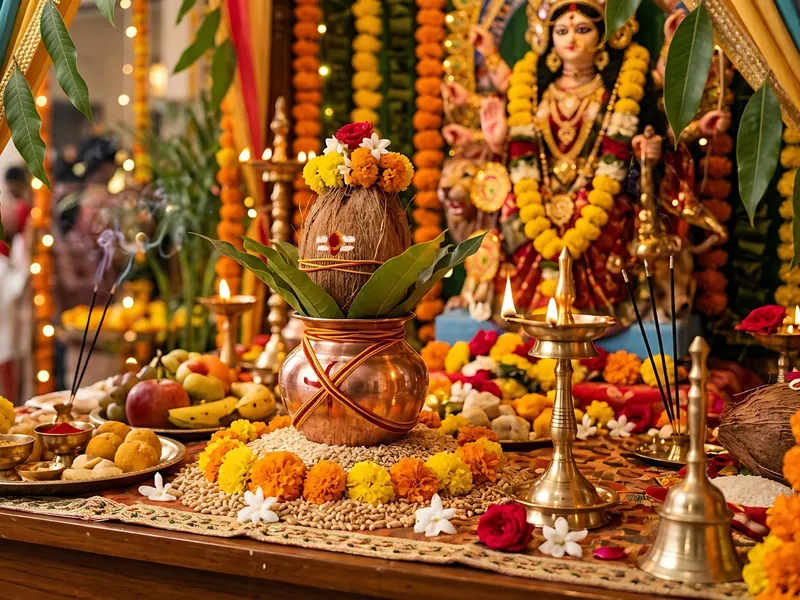
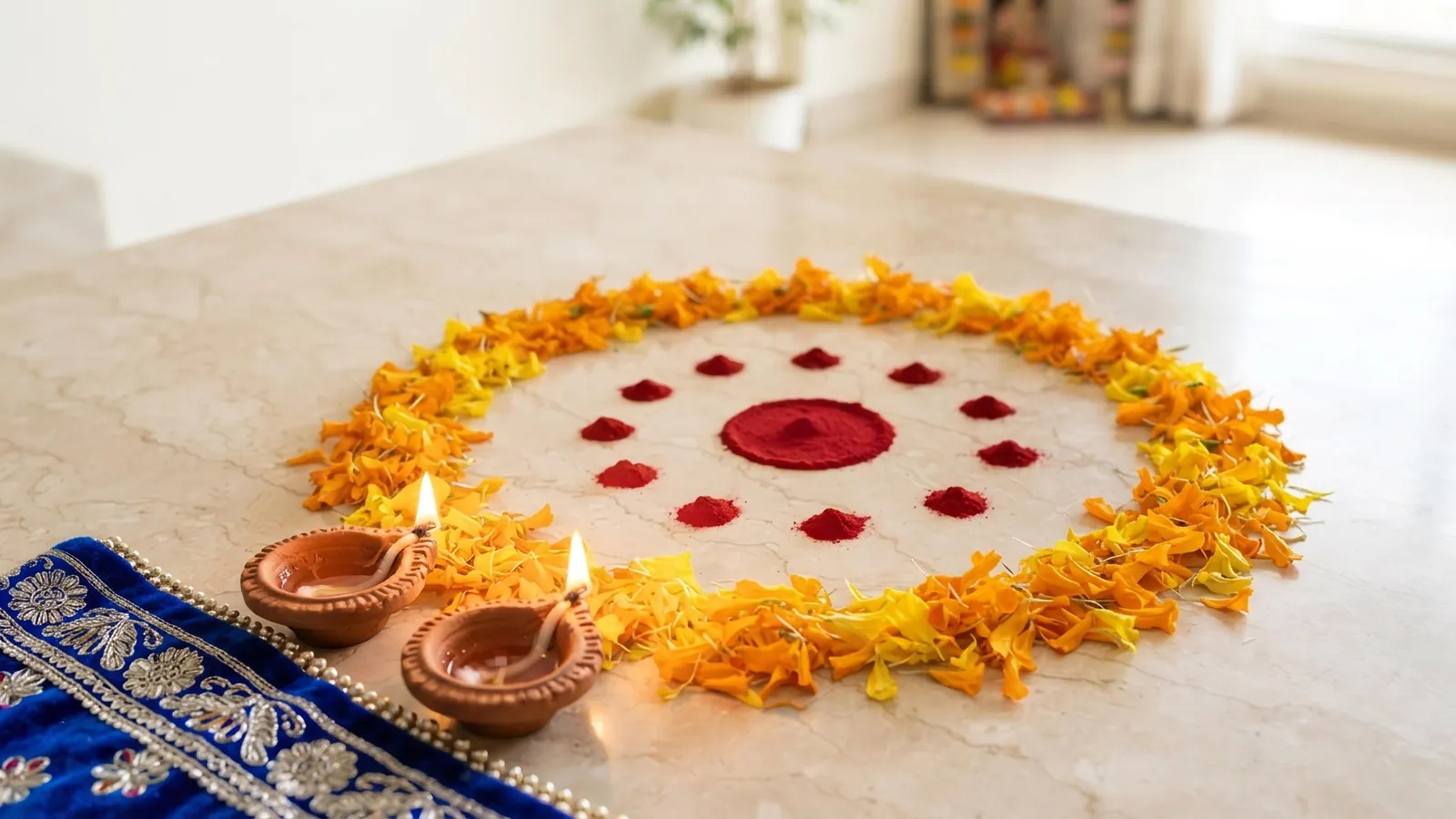
The new-moon night is the centre of the festival. Homes are cleaned, doorways are decorated with marigolds and rangoli, and after sunset Lakshmi is worshipped with Ganesha, often with Saraswati too. Lamps are set on sills, steps and rooftops, in the belief that Lakshmi visits homes that are clean and lit.
Panchangs recommend doing the puja during pradosh, the period of roughly two and a half hours after sunset, while the new moon lasts. They give particular weight to the part of it that falls in a sthir ("fixed") lagna, usually Vrishabha (Taurus), because a fixed rising sign is thought to help prosperity stay in the home. Gujarati business families perform Chopda Pujan at this time, blessing the new account books.
The same night carries other memories. Across the North it marks Rama's return to Ayodhya with Sita and Lakshmana after fourteen years of exile, when the city lit lamps to welcome him. For Jains it is the day Mahavira attained nirvana at Pavapuri. In Bengal, Odisha and Assam the new moon belongs to Kali, worshipped late into the night as Shyama Puja.
Lead me from the unreal to the real. Lead me from darkness to light. Lead me from death to immortality.
Day four: Govardhan Puja, Bali Pratipada and the new year
On the first day of the bright fortnight, much of North India keeps Govardhan Puja. It recalls Krishna lifting Govardhan hill to shelter the people of Braj from Indra's storms. The day is also called Annakut, "mountain of food", because a large offering of grains, vegetables and sweets is heaped up for Krishna and then shared.4
In Maharashtra the day is Bali Pratipada or Padva. It honours King Bali, whom Vishnu as Vamana sent to the underworld but allowed to return to the earth each year because of his generosity. Gujarat begins its new year on this day, and across India it is a time for visiting family and friends and exchanging gifts.
Day five: Bhai Dooj
Bhai Dooj closes the festival on the second lunar day. Sisters apply a tilak to their brothers' foreheads, perform aarti and serve a meal, and brothers give gifts in return. The day is also called Yama Dwitiya, after the story of Yama visiting his sister Yamuna, who welcomed him with a tilak and a meal. It is known as Bhau Beej in Maharashtra and Bhai Phonta in Bengal.5
Diwali 2026: dates and times for New Delhi
- DhanterasFriday 6 November. Puja 6:02 to 7:57 pm; Yama Deepam the same evening.
- Naraka ChaturdashiSunday 8 November. Abhyanga snana 5:41 to 6:38 am.
- Lakshmi PujaSunday 8 November. Pradosh 5:31 to 8:09 pm; Lakshmi Puja muhurta (pradosh with Vrishabha lagna) 5:54 to 7:50 pm. Amavasya runs from 11:27 am on 8 November to 12:31 pm on 9 November.
- Govardhan Puja, Annakut, Bali Pratipada and Gujarati New YearTuesday 10 November. Morning muhurta 6:40 to 8:50 am.
- Bhai DoojWednesday 11 November. Afternoon tilak time 1:10 to 3:20 pm.
These times follow Drik Panchang for New Delhi and will shift by city. Some calendars place a day differently: certain printed calendars mark 7 November as Choti Diwali, since Chaturdashi begins that morning, and the central government's 2026 restricted-holiday list puts Govardhan Puja on 9 November.7
A simple way to begin
- Clean and clear one room or corner in the days before Dhanteras, and light a lamp outside the door on Dhanteras night.
- On Lakshmi Puja evening, set up Lakshmi and Ganesha on a clean cloth, offer flowers, sweets and a lamp, and say a short prayer during the pradosh muhurta.
- Light diyas in every room and at the threshold; clay lamps and oil are traditional.
Questions
Common questions
Why are Choti Diwali and Lakshmi Puja on the same day in 2026?
The Naraka Chaturdashi bath must be taken before sunrise while Chaturdashi lasts, and Lakshmi Puja is held when Amavasya covers the evening. At New Delhi in 2026, Chaturdashi is current at dawn on 8 November and Amavasya begins at 11:27 am, so both fall on Sunday 8 November.
What is the best time for Lakshmi Puja in 2026?
For New Delhi, Drik Panchang gives 5:54 to 7:50 pm on Sunday 8 November, the part of pradosh that falls in the fixed Vrishabha lagna. Other cities differ: Kolkata's window starts earlier and Mumbai's later.
Why is there a gap day between Diwali and Govardhan Puja this year?
Govardhan Puja is kept on Pratipada, the first lunar day after the new moon. In 2026 Amavasya lasts until 12:31 pm on 9 November, so Pratipada first covers sunrise on 10 November.
Sources
Where this comes from
- Drik Panchang2026 Diwali Puja | Lakshmi Puja Timings for New Delhi, NCT, Indiadrikpanchang.com
- Drik Panchang2026 Dhantrayodashi | Dhanteras Puja Date and Timings for New Delhidrikpanchang.com
- Drik Panchang2026 Abhyang Snan on Narak Chaturdashi for New Delhidrikpanchang.com
- Drik Panchang2026 Govardhan Puja | Annakut Puja Date and Time for New Delhidrikpanchang.com
- Drik Panchang2026 Bhai Dooj | Bhau Beej Date and Time for New Delhidrikpanchang.com
- Press Information Bureau, Government of IndiaA Glowing Recognition: Diwali Added to UNESCO's Intangible Cultural Heritage List (10 Dec 2025)static.pib.gov.in
- GConnect, reproducing the Department of Personnel and Training orderHolidays to be Observed in Central Government Offices During the Year 2026 (DoPT order, 3 Jul 2025)gconnect.in
We write from the texts and references listed above, in plain English. Customs vary between regions, communities and families. Where your family has its own practice, follow it, or ask your family priest.
Take it further
A Lakshmi puja in your nameIf you cannot be home for Diwali, our learned pandits can perform the puja with a sankalp in your name, gotra and nakshatra, and send you the video the same day.
See puja on your behalf Keep reading