Shodashopachara: the sixteen offerings of a formal puja
Why a formal puja unfolds like a host welcoming an honoured guest, what each of the sixteen upacharas means, and the five-step form for home.

On this page
In brief
- 1Shodashopachara means sixteen acts of service: a puja is structured as hospitality to the deity, from welcome to farewell.
- 2The exact sixteen differ between texts, lineages, regions and families; the arc of welcome, care, offering and leave-taking stays constant.
- 3Panchopachara, the five offerings of fragrance, flowers, incense, lamp and food, is the usual short form for daily home worship.
Watch a pandit perform a full puja and the sequence can look intricate: water poured and set aside, cloth offered, a lamp waved, betel leaves placed on a plate. Yet the logic underneath is familiar to anyone raised in an Indian home. The deity is being received the way a respected guest is received, from arrival to a courteous farewell.
That sequence of courtesies is called shodashopachara, from shodasha (sixteen) and upachara (an act of service or attendance). Below we walk through the sixteen, look at what each one means as hospitality, and describe the five-step version many families use every day.
Worship as hospitality
Encyclopaedia Britannica describes puja as ceremonial worship that ranges from brief daily rites at home to elaborate temple ritual, with the deity in the image generally honoured as a royal guest. In large temples this care runs through the whole day: the image is gently woken, bathed, dressed, served its meals and, at night, put to rest.3
Harvard's Pluralism Project sums up Hindu puja as a sequence of hospitality rites, in which the worshipper honours the deity with offerings and receives grace in return. Scholars trace the pattern a long way back. The early household manuals known as the Grihya-sutras describe rites of welcome for honoured visitors, and as devotional (bhakti) religion grew, the same courtesies came to be offered to the gods themselves.
The exchange completes itself when food that has been offered returns to the household as prasada, understood to carry the deity's blessing. The guest has been fed, and the host is fed in turn.
The sixteen upacharas
What follows is one widely used sequence, drawn from published puja guides. The Sanskrit name comes first, then what the step means as an act of hospitality. In practice each step is usually accompanied by a short mantra in which the worshipper names what is being offered.
- Avahana
- Invitation. After a moment of meditation (dhyana) on the deity's form, the worshipper invites the deity to be present in the image, the kalash or the heart. A host first asks the guest in.
- Asana
- A seat. The guest is offered a place to sit, often represented by a flower or a few grains of rice placed before the image.
- Padya
- Water for the feet. In a hot country the first kindness to a traveller is water to wash away the dust of the road.
- Arghya
- Water for the hands, offered as a mark of honour.
- Achamaniya
- Water to sip, so the guest can rinse the mouth and feel refreshed.
- Snana
- A bath. Plain water at the least; longer pujas use panchamrita (milk, curd, ghee, honey and sugar) while hymns are chanted.
- Vastra
- Clothing. Fresh cloth is offered after the bath.
- Yajnopavita
- The sacred thread, offered after the cloth in many lists.
- Gandha
- Fragrant paste: sandalwood, with kumkum, turmeric or sacred ash according to family and sect.
- Pushpa
- Flowers. In longer pujas a flower is offered with each of the deity's 108 or 1,008 names.
- Dhupa
- Incense, so the guest's surroundings are fragrant.
- Dipa
- A lit lamp, the offering of light.
- Naivedya
- Food, freshly prepared and offered before anyone else eats, followed by a little water.
- Tambula
- Betel leaf and nut, the customary close to a good meal; sometimes a coin is placed with it.
- Nirajana
- The waving of a camphor flame or lamp, better known as arati, the same honour Indian households show a special guest.
- Pradakshina and namaskara
- Circling the deity clockwise (or turning in place), bowing, asking pardon for any lapse, and taking leave with thanks.
Why the lists do not always match
Compare two puja books and you will rarely find the same sixteen in the same order. The Hindu American Foundation's guide to the sixteen steps notes that grouping and sequence differ by sampradaya (lineage), by deity, by region and community, and by family custom. Britannica likewise observes that the components of a puja vary with sect, region, time of day and the text being followed.
Some examples of the variation: the list recorded in V. S. Apte's Sanskrit dictionary begins with the seat, includes svagata (words of welcome), madhuparka (a refreshing honey mixture traditionally given to an honoured guest) and ornaments, and ends with vandana (salutation). A list in Molesworth's Marathi dictionary includes dakshina (an offering of money) and mantrapushpa (flowers offered with mantras). Some ritual texts count five or ten upacharas; tantric manuals describe as many as sixty-four.
The shape, though, holds steady across them: welcome, refreshment, bathing and dressing, adornment, the sensory offerings, a meal and a respectful farewell. The number sixteen is best understood as a frame for that arc rather than a fixed checklist.
Panchopachara: the five-offering form
Few households perform all sixteen every day. The usual shorter form is panchopachara, the five services, which keeps the offerings at the heart of the sequence: gandha (fragrant paste), pushpa (flowers), dhupa (incense), dipa (lamp) and naivedya (food). Swami Harshananda's Concise Encyclopedia of Hinduism lists these five and notes that upacharas are commonly counted as five, ten or sixteen.
The Hindu American Foundation's guide connects these five central steps to the five senses. One way to read this is that the worshipper offers back the very faculties through which the world is enjoyed.
A simple way to begin at home
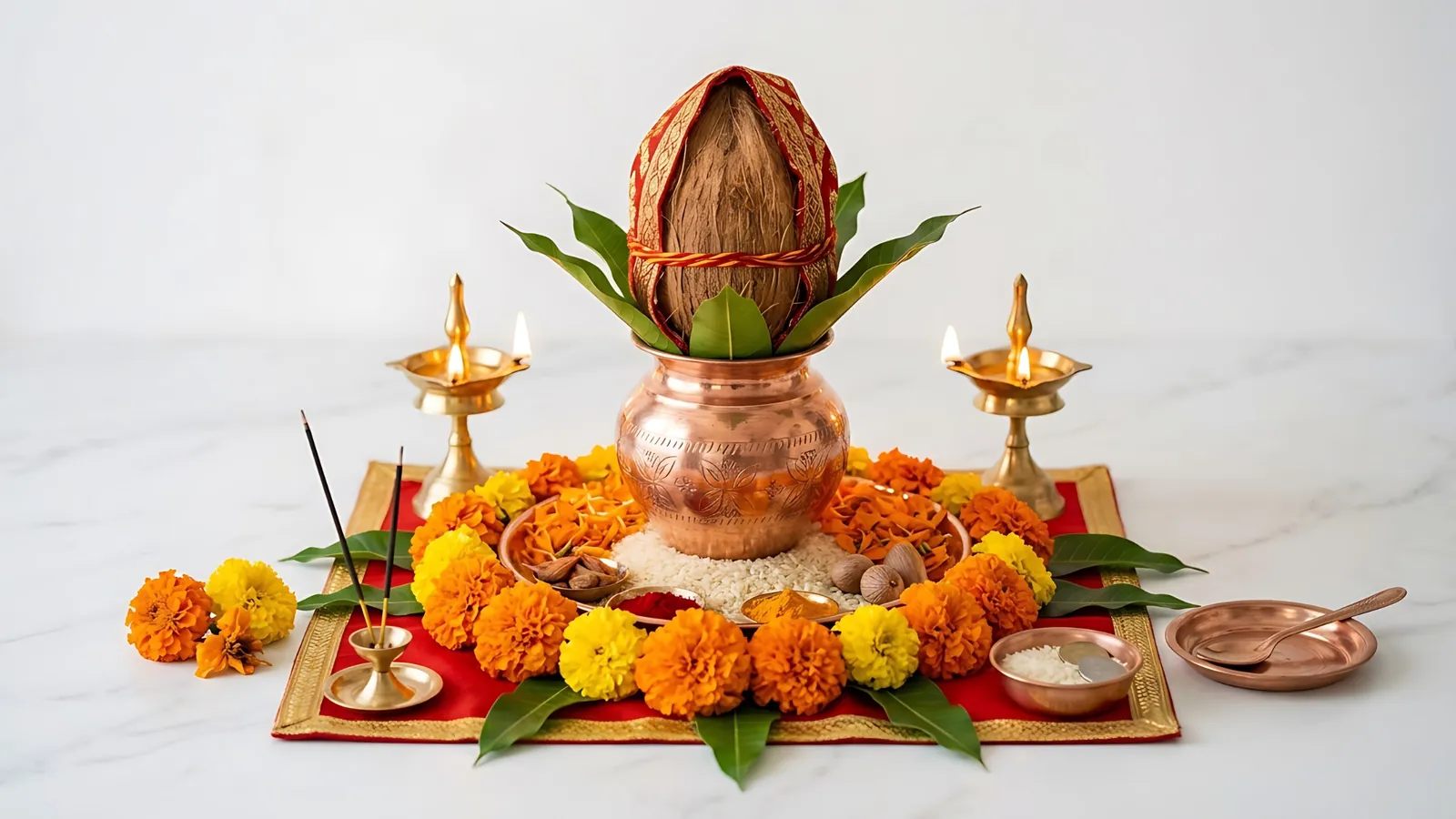
A daily panchopachara puja can take ten minutes. Gather a little water, sandalwood paste or kumkum, a few flowers, an incense stick, a ghee or oil lamp, and some fruit or a sweet.
- Wash your hands and feet and sit before the shrine on a clean mat.
- Sit quietly for a moment and call the deity to mind, by name or with a short verse you know.
- Offer gandha: touch a little paste to the image or to the flowers.
- Offer the flowers, saying the deity's name as you place each one.
- Light the incense and wave it gently before the image, then light the lamp and offer it.
- Place the food before the deity, offer a little water after it, and later share it as prasada.
- Close with a bow and, if you wish, a short arati and a clockwise turn in place.
Doing fewer steps with attention sits comfortably within tradition. The Hindu American Foundation's guide points out that a devotee may do far fewer than sixteen steps, such as lighting a lamp and chanting a mantra, and that on festival days the same steps are simply expanded.
The point beneath the detail
It is easy to get lost in which water comes first or whether ornaments precede fragrance. The sixteen upacharas carry a simpler idea. The divine needs nothing from us, yet the worshipper chooses to serve as a good host would, with cleanliness, generosity and care, and in doing so learns to give attention fully.
Whether the puja you perform has sixteen steps or five, the measure is the same: was the guest welcomed, served well and thanked.
Questions
Common questions
Do I need to perform all sixteen upacharas at home?
No. Most families use the five-offering form, panchopachara, for daily worship and keep the full sixteen for festivals or special pujas. Guides to home worship note that far fewer steps, offered with attention, are entirely acceptable.
What is the difference between shodashopachara and panchopachara?
Shodashopachara is the full sixteen-step sequence that treats the deity as an honoured guest, including welcome, washing, bathing, dressing and farewell. Panchopachara keeps only the five central offerings: fragrant paste, flowers, incense, lamp and food.
Why do different puja books give different lists of sixteen?
The sixteen developed across many texts and lineages, and regional and family customs shaped them further. Some lists include madhuparka, ornaments or dakshina, while others include the sacred thread or arati. The underlying sequence of hospitality is shared.
Sources
Where this comes from
- Encyclopaedia BritannicaPuja (Hinduism)britannica.com
- The Pluralism Project, Harvard Universitypujapluralism.org
- EBSCO Research Starters (Cait Caffrey)Puja (ceremonial worship)ebsco.com
- Hindu American Foundation (Suhag Shukla)How to conduct a traditional 16-step Hindu pujahinduamerican.org
- Free Press Journal (S. Ainavolu)Guiding Light: Shodasha Upacharasfreepressjournal.in
- Hindupedia (from Swami Harshananda, A Concise Encyclopedia of Hinduism)Pancopacarashindupedia.com
- Wisdom Library (compiling Apte, Shabda-Sagara and Molesworth dictionaries)Shodashopacara: definitionswisdomlib.org
We write from the texts and references listed above, in plain English. Customs vary between regions, communities and families. Where your family has its own practice, follow it, or ask your family priest.
Take it further
A full puja, performed for youFor festivals and family occasions, our learned pandits perform the complete puja in India with your sankalp, and share the video the same day.
See puja on your behalf Keep reading