Shruti and smriti: a reader's map of Hindu scripture
From the four Vedas and the Upanishads to the epics, Puranas, Agamas and bhakti poetry: how Hindu scripture fits together, and where to start.

On this page
In brief
- 1Shruti (the Vedas, with their Samhita, Brahmana, Aranyaka and Upanishad layers) is regarded as revealed; smriti is the later, remembered tradition built on it.
- 2Smriti includes the Ramayana and Mahabharata (with the Gita), the eighteen Mahapuranas and the Dharmashastras; Agamas, Tantras and regional bhakti poetry sit alongside.
- 3Scholarly dates are estimates, and traditional views of the Vedas' age and authorship differ from them.
Hindu tradition has no single holy book. It has a library, composed and handed down over some three thousand years in Sanskrit, Tamil and many other languages, much of it memorised and chanted long before it was written.
This map is a way to find your bearings: the main bodies of text, how they relate to one another, and where a curious reader might sensibly begin.
A word on dates. The dates below are estimates given by modern scholars, mostly from linguistic and textual evidence. Traditional Hindu thought holds the Vedas to be apaurusheya, not of human authorship, and eternal, and Indian scholars have proposed dates for the Vedas ranging from around 1200 BCE to many thousands of years earlier. Treat every date here as an approximate scholarly view, not a settled fact.
Two kinds of authority: shruti and smriti
The tradition sorts its texts into two broad kinds. Shruti, "that which is heard", is the Veda, understood as revealed to the ancient seers (rishis) and passed on orally. It carries the highest authority.
Smriti, "that which is remembered", is the much larger body of later texts composed to explain, organise and apply Vedic teaching: the epics, the Puranas, manuals of ritual and law. Its authority is understood to rest on the Veda, yet for many Hindus it is the more familiar of the two.1
The four Vedas
- Rigveda
- The oldest of the four: an anthology of sacred hymns, the foundation on which much of the later ritual and poetry draws.
- Yajurveda
- Prayers and sacrificial formulas used by priests in the conduct of ritual.
- Samaveda
- Hymns, many taken from the Rigveda, set to melody for chanting.
- Atharvaveda
- A collection that includes incantations and spells alongside hymns.
UNESCO describes the Vedic corpus as composed more than 3,500 years ago, which places the oldest hymns in the second millennium BCE. The Vedas survived through exacting methods of oral recitation, and UNESCO recognised the tradition of Vedic chanting as intangible cultural heritage of humanity (proclaimed 2003, inscribed 2008).2
Four layers within each Veda
Each Veda is not one book but a layered body of texts. Some teachers treat the last two layers as part of the earlier ones rather than separate.
- Samhita: the core collection of hymns, chants or ritual formulas.
- Brahmana: prose explanations of ritual, its procedure and its meaning.
- Aranyaka: the "wilderness" texts, esoteric teachings meant for study away from village life.
- Upanishad: philosophical teachings on the relation between the self (atman) and ultimate reality (brahman).
Because the Upanishads conclude the Veda, they are also called Vedanta, the conclusion of the Veda, a name later taken by the philosophical schools built on them.
The principal Upanishads
Many texts carry the name Upanishad, some composed as late as about 1400 CE. Scholars single out thirteen early ones, and Britannica dates the earliest to roughly the middle of the first millennium BCE.4
- In prose mixed with verse: Brihadaranyaka, Chandogya, Taittiriya, Aitareya and Kaushitaki.
- Mostly in verse: Kena, Katha, Isha, Shvetashvatara and Mundaka.
- In prose: Prashna, Mandukya and Maitri.
The Itihasas: Ramayana and Mahabharata
Itihasa means roughly "so it happened". Hindus read the two great epics both as history and as teaching on dharma, right living.
The Ramayana, traditionally ascribed to the poet-sage Valmiki, tells the life of Rama in seven books. The Mahabharata, traditionally ascribed to Vyasa, runs to almost 100,000 couplets in eighteen books (parvans), with a supplement, the Harivamsha. Britannica describes it as reaching its present form around 400 CE.5
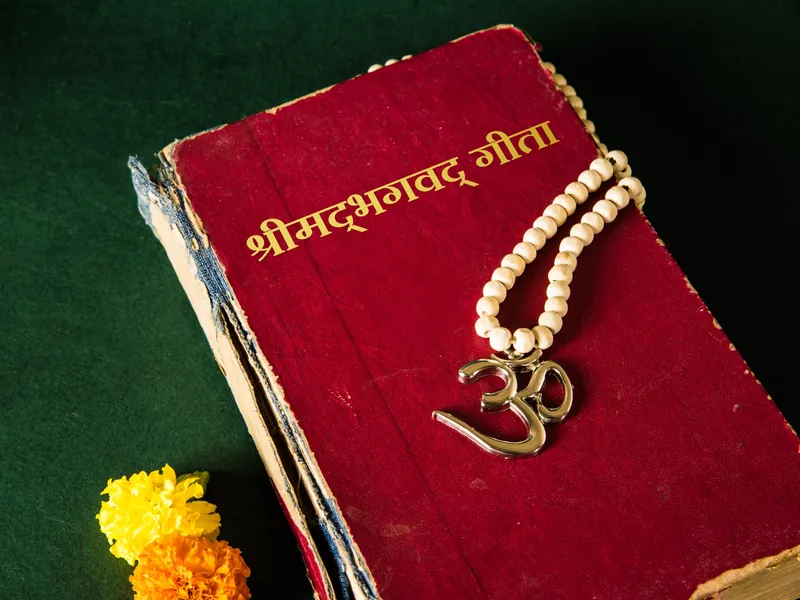
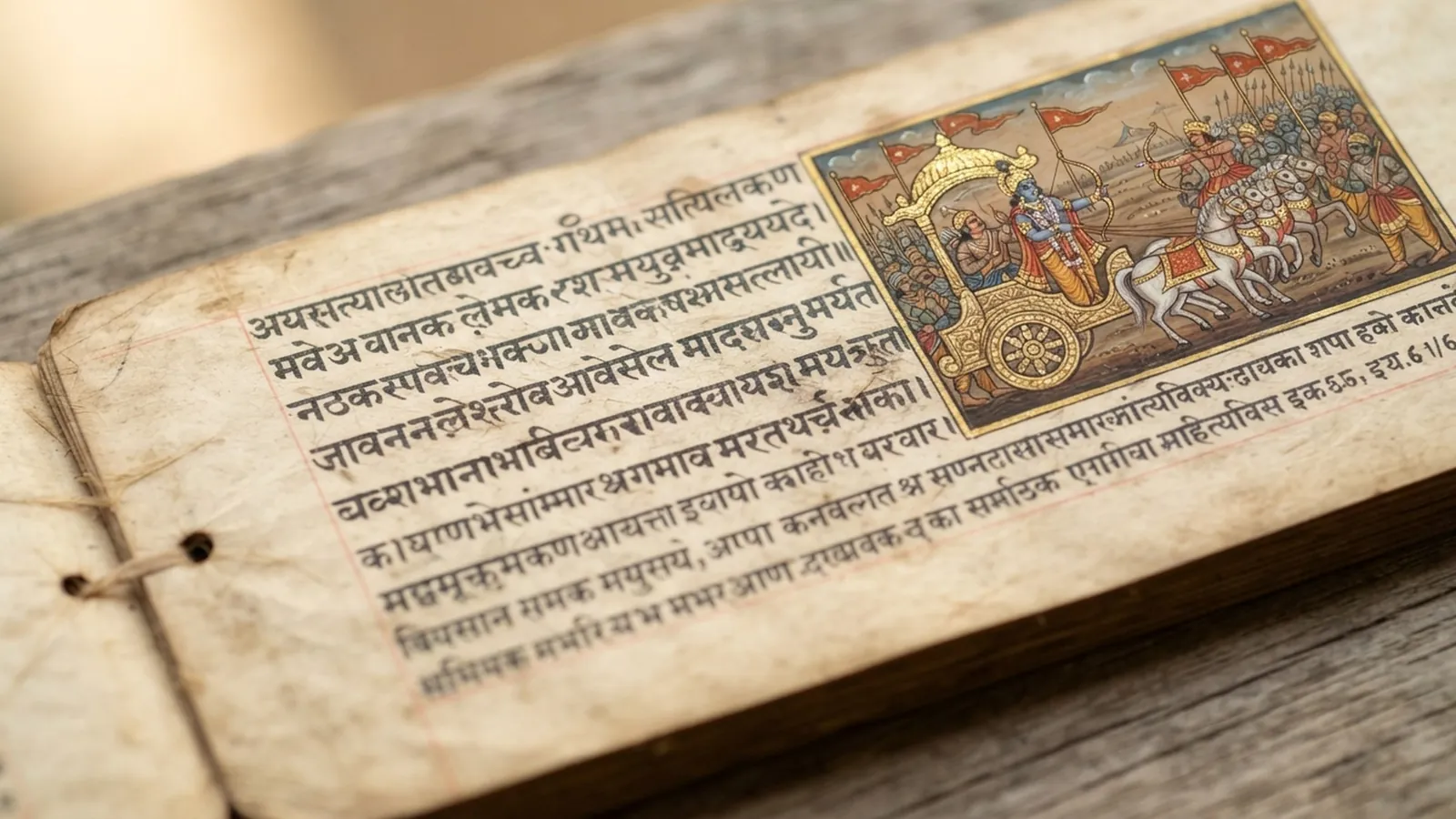
The Bhagavad Gita, Krishna's teaching to Arjuna on the eve of battle, sits within the Mahabharata's sixth book. Strictly it is smriti, though many Hindus treat it with the reverence given to shruti.
The eighteen Mahapuranas
The Puranas, "ancient lore", are encyclopaedic collections of myth, legend, genealogy and devotion. Tradition counts eighteen major ones, though the lists themselves differ. They are classically said to cover five subjects: creation, re-creation after dissolution, the genealogies of gods and sages, the ages of the Manus, and the histories of the solar and lunar dynasties.
Most are devoted chiefly to Vishnu, to Shiva or to the Goddess. Britannica gives broad bands of composition: an earliest group, including the Vishnu, Markandeya, Matsya and Vayu Puranas, between about 350 and 750 CE; a second, including the Bhagavata, Padma, Shiva and Skanda, between 750 and 1000; and later works up to about 1500. The Bhagavata Purana, with its account of Krishna's childhood, is the most widely loved.6
Around them sit eighteen lesser upapuranas and a great many sthala-puranas and mahatmyas, which praise a particular temple or sacred place and are often recited there.
The Dharmashastras
The Dharmashastras are treatises on conduct: personal and household duties, rites of passage, social and legal rules. Over time the word smriti came to refer above all to these law books, of which the Manusmriti is the best known.
They reflect the social world of their authors, and modern readers, Hindu and otherwise, read them historically and selectively rather than as a rulebook for today.
Agamas and Tantras
The Agamas are post-Vedic scriptures of ritual knowledge, understood as revealed by a personal deity; many are framed as dialogues between Shiva and Parvati. They contain early guidance on building temples, making sacred images and conducting worship.
There are three broad families: the Shaiva Agamas, the Vaishnava Samhitas and the Shakta Tantras. Britannica dates the Shaiva scriptures probably to the eighth century. Their influence runs through Shaiva Siddhanta, Kashmir Shaivism and the Lingayat tradition.
Devotional literature in regional languages
Alongside Sanskrit, devotion (bhakti) found its voice in the languages people spoke at home. The Tamil hymns of the Alvars, devotees of Vishnu, and the Nayanars, devotees of Shiva, are still sung in temple worship. Later came, among many others, the Kannada sayings (vacanas) of the Lingayat saints, the Marathi songs of the Varkari poets, and Tulsidas's Ramcharitmanas in Awadhi.
Scholars note that later Puranas themselves absorbed local and vernacular traditions. For many families, these regional works are the scripture they actually sing and recite.
Where to start reading
A gentle path is to begin with the Gita, move to two or three short Upanishads such as the Isha and Katha, and keep an epic retelling at the bedside. These translations are reliable and widely available:
- Bhagavad Gita: Swami Gambhirananda or Swami Sivananda (both also on the Gita Supersite); Eknath Easwaran (Nilgiri Press); Laurie L. Patton (Penguin Classics).
- Upanishads: Patrick Olivelle, Upanisads (Oxford World's Classics); Eknath Easwaran, The Upanishads (Nilgiri Press); Swami Gambhirananda, Eight Upanisads with Shankara's commentary (Advaita Ashrama).
- Vedas: Wendy Doniger, The Rig Veda: An Anthology (Penguin Classics); Stephanie Jamison and Joel Brereton, The Rigveda (Oxford University Press); Ralph T. H. Griffith's 1890s translation, public domain though dated in style.
- Epics: C. Rajagopalachari's retellings of the Ramayana and Mahabharata (Bharatiya Vidya Bhavan); Arshia Sattar's abridged Valmiki Ramayana (Penguin); Bibek Debroy's unabridged Mahabharata (Penguin).
- Puranas: Edwin F. Bryant, Krishna: The Beautiful Legend of God, from the Bhagavata Purana (Penguin Classics); Gita Press, Gorakhpur editions with Sanskrit and translation.
- Dharmashastra: Patrick Olivelle, The Law Code of Manu (Oxford World's Classics).
- Regional devotion: A. K. Ramanujan, Speaking of Siva (Penguin) for Kannada vachanas; the Gita Press Ramcharitmanas with English translation.
Questions
Common questions
Is the Bhagavad Gita shruti or smriti?
Formally it is smriti, since it is part of the Mahabharata. In practice it is revered almost as highly as the Upanishads, and many teachers treat it as a summary of their teaching.
How old are the Vedas?
Scholars generally place the oldest hymns in the second millennium BCE, and UNESCO speaks of a corpus over 3,500 years old. Traditional Hindu thought regards the Vedas as eternal and not of human authorship, and Indian scholars have proposed a wide range of earlier dates.
I have never read any scripture. Where should I begin?
Start with a good translation of the Bhagavad Gita, then a short Upanishad such as the Isha or Katha, and read a retelling of the Ramayana or Mahabharata alongside.
Sources
Where this comes from
- Vedic Heritage Portal, Ministry of Culture / IGNCA, Government of IndiaIntroduction (Veda, shruti and smriti, apaurusheyata, age and classification of Vedic literature)vedicheritage.gov.in
- UNESCO Intangible Cultural HeritageTradition of Vedic chantingich.unesco.org
- Encyclopaedia BritannicaSmritibritannica.com
- Encyclopaedia BritannicaUpanishadbritannica.com
- Encyclopaedia BritannicaMahabharatabritannica.com
- Encyclopaedia BritannicaPuranabritannica.com
- Encyclopaedia BritannicaAgamabritannica.com
We write from the texts and references listed above, in plain English. Customs vary between regions, communities and families. Where your family has its own practice, follow it, or ask your family priest.
Take it further
Not sure where to begin reading?Tell a Vedic consultant what you are looking for, and we will suggest a path through the texts that suits you.
Spiritual consultation Keep reading